Common Configurations and Applications of Small Service Vessels

Small service boats,anchor boats,supply boats,towing boats,mooring boats are a type of light ship used for specific services at sea or in inland waterways. They are typically between 20 and 100 meters in length and feature flexibility and multi-functionality. They are widely applied in fields such as ports, marine engineering, fishing, and scientific research. The following explanation is provided from two aspects: common configurations and typical applications.
I. Common Configurations of Small Service Vessels
The configuration of small service vessels varies depending on their purposes, but the core design focuses on functionality and adaptability, mainly including the following modules:
Hull and Structural Design
• Materials: Mostly steel (high strength, collision-resistant) or aluminum alloy (lightweight, corrosion-resistant) are used. Some high-speed boats use fiberglass.
• Hull type: Choose according to requirements. For instance, tugs often use round bilge type (good stability), catamarans (large deck area), and deep V type (good seakeeping); port workboats are mostly hydrofoils or planing boats (high speed).
• Dimensions and Layout: Emphasis is placed on compactness, with deck space reserved for equipment installation (such as winches and cranes), and the living quarters are simplified (only meeting the basic needs of crew members/operators).
2. Power and Propulsion System of the small service boats,anchor boats,supply boats,towing boats,mooring boats
• Power source: Mainly medium-speed diesel engines (such as Cummins, Caterpillar), and some small vessels use gasoline engines or electric motors (in environmental protection scenarios).
• Propulsion method:
• Conventional propellers (low cost, suitable for low speed);
• Full rotary thrusters (Z-type rudder propellers, 360° steering, commonly used in tugboats and supply vessels);
Water jet propulsion (for high-speed boats, with no risk of propeller entanglement);
Podded propulsion (integrating motor and propeller, saving space, for high-end vessel types).
• Endurance: Small vessels are typically equipped with fuel tanks (with a capacity of 50 to 500 tons), and have an endurance range of 500 to 2,000 nautical miles (depending on mission requirements).
3. Navigation and Communication Systems of the small service boats,anchor boats,supply boats,towing boats,mooring boats
Navigation equipment: GPS or Beidou positioning, electronic chart (ECDIS), radar (ARPA collision avoidance), depth sounder, compass (magnetic compass/electronic compass), automatic identification system (AIS).
Communication equipment: VHF radio, satellite phone (for distant seas), emergency position-indicating radio beacon (EPIRB), and navigation telex receiver (NAVTEX).
• Monitoring equipment: CCTV (deck monitoring), power system status monitoring (such as oil temperature, speed sensors).
4. Deck and Specialized Equipment
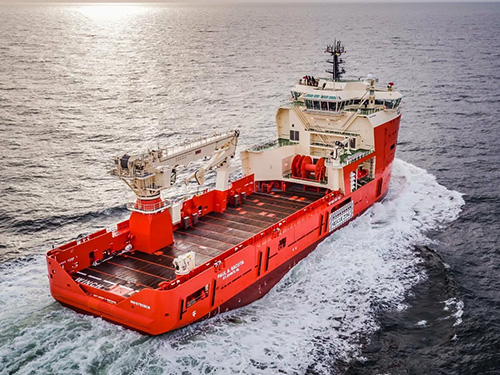
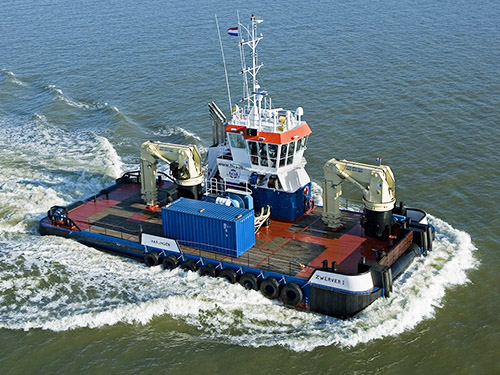
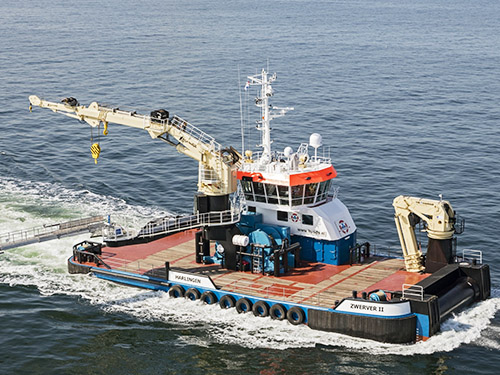
Deck machinery: Electric or hydraulic winches (traction force 5-50 tons, for towing and anchoring), folding boom cranes (lifting capacity 1-20 tons, for cargo handling), and roll-on,roll-off ramps (for vehicles and materials to embark and disembark).
Safety equipment: Fire protection system (fire extinguishing, water mist device), lifeboats,rafts, life jackets, oil spill recovery equipment (essential for eco-friendly vessels), first aid kits.
• Special function equipment (customized according to application):
• Diving support vessel: decompression chamber, diving bell interface, remotely operated vehicle (ROV) launching and recovery frame;
• Research support vessel: Sampling winch (CTD temperature, salinity and depth instrument), hydrological measurement equipment (ADCP acoustic Doppler current profiler);
Supply vessel: Liquid cargo piping system (fuel and water transfer), dry cargo fixed racks;
• Tugboat: Side thruster (enhancing berthing flexibility), high-strength towing winch.
5. Functional compartments and modular design for the service boats,anchor boats,supply boats,towing boats,mooring boats
• Cargo holds: Dry cargo holds (containers or bulk cargo), liquid cargo holds (fuel,water,drilling fluid), refrigerated holds (fish preservation).
• Work compartments: Tool room (for storing maintenance tools), laboratory (on research vessels), control room (for centralized operation of navigation and equipment).
• Living quarters: Simple crew cabins (2-4 persons per cabin), kitchen, bathroom. Some vessels are equipped with temporary rest areas (for on-board operation personnel).
II. Typical Applications of Small Service Vessels
Port and waterway services
• Tugboat: Assists large vessels in berthing and unberthing, as well as moving berths at the wharf, and tows unpowered vessels (such as barges). It is equipped with a full-rotating propeller and a high-power main engine (with a thrust of 50 to 200 tons), and is commonly seen in commercial ports and oil ports.
• Pilot Boat: It is used to pick up and drop off pilots on foreign vessels and requires high speed (25-35 knots) and good seakeeping ability (catamarans are common).
Work Boat: Short-distance transportation of port personnel and materials (such as crew changeover and spare parts delivery), mostly aluminum alloy speedboats (10-20 meters).
2. Marine Engineering Support
Platform Supply Vessel (PSV): It transports fuel, fresh water, food and equipment for offshore oil and gas platforms and wind farms. It is equipped with liquid cargo pumps and cranes (with a lifting capacity of 5 to 15 tons). Some vessels also serve as anchor handling tug supply vessels (AHTS).
• Maintenance Vessel: Equipped with welding and cutting tools, it offers minor repair services to platforms or subsea pipelines and is often accompanied by divers for boarding the platform.
3. Fishery Services
• Fish Carrier: Transports the catch from fishing vessels to processing plants, equipped with refrigerated holds or ice-cooled holds (preserved with crushed ice).
Fisheries Support Vessel: It supplies fuel, fresh water and ice to fishing vessels, offers simple maintenance services (such as replacing fishing nets), and some of these vessels also serve as fishery patrol boats.
4. Scientific Expedition Assistance
• Survey Vessel: Equipped with hydrographic, geological and biological survey equipment (such as multi-beam echo sounders and shallow subsurface profilers), it supports marine resource exploration or environmental investigation.
Diving Support Vessel: It provides a platform for divers or ROV operations for underwater archaeology and pipeline inspection, and is equipped with decompression chambers and underwater lighting systems.
5. Emergency Rescue and Environmental Protection
• SAR Boat: Participates in the rescue of people in distress at sea, equipped with stretchers and medical compartments, and often works in coordination with helicopters .
Oil Spill Response Vessel: It cleans oil spills on the sea surface by using oil booms and oil-absorbing pads. Some vessels are equipped with oil skimmers.
6. Other scenarios of the small service boats,anchor boats,supply boats,towing boats,mooring boats.
• Offshore wind farm operation and maintenance vessel : It provides regular maintenance for wind turbines in wind farms, equipped with a fast access ramp (gangway for personnel transfer), and some vessels are fitted with dynamic positioning systems.
Tourist Boat: Passenger-carrying sightseeing vessels on inland rivers or near the coast (such as an upgraded version of the Li River bamboo raft or coastal sightseeing boats), emphasizing comfort and the design of viewing decks.
Summary
The core advantage of small service vessels lies in their "small but specialized" nature, which enables them to adapt to diverse demands through modular configuration. With the development of the marine economy, they are evolving towards intelligence (such as unmanned vessels), green energy (electric or hybrid power), and multi-functionality. In the future, their applications in emerging fields such as deep-sea development and offshore wind power will become even more extensive.